
Turn climate science into sovereign bond decisions
The Climate Change Performance Index (CCPI) is a science-based, independently developed tool for evaluating the climate protection performance of 60+ countries. Built by NGOs and climate experts.

Trusted data source for international media and research






The country-level climate data gap
Despite growing regulatory pressure and market demand, most climate data for sovereigns remains fragmented, unclear, or misaligned with Paris goals.
01
Too many climate KPIs, no guidance on relevance or weighting
02
Complex data, but no headline signal
03
Opaque methodologies, unclear assumptions
04
Misalignment with Paris Agreement goals
05
Lack of time-series data
06
Conflicting scores, little local insight
What makes the CCPI stand out
Not just more data. Better data. The CCPI turns climate science into real insight.
Global scope, local depth
Covers 60+ countries representing >90% of global emissions. All major sovereign bond issuers included. Upadated annually.
From granular to aggregated
Detailed scores across 14 indicators, but also an intuitive overall rating to support strategy, reporting, and engagement.
Paris-aligned trajectories
Scores benchmarked against well-below-2°C pathways, grounded in “common but differentiated responsibilities”.
Beyond carbon
Evaluates sovereigns across four critical transition pillars: GHG emissions, renewable energy, energy use, and climate policy.
Forward-looking KPIs
Used for transition risk analysis: Indicators include 2030 target assessments and pathway alignment based on the Paris Agreement.
Deep climate expertise
Developed by a leading NGO and 450+ local experts across the globe.

For (...) data relating to sovereign emissions, it is recommended that members consider (...) [the] Climate Change Performance Index
UN-convened Net-Zero Asset Owner Alliance
Background document, Apr 2024
ONE NUMBER
Cross-country comparability
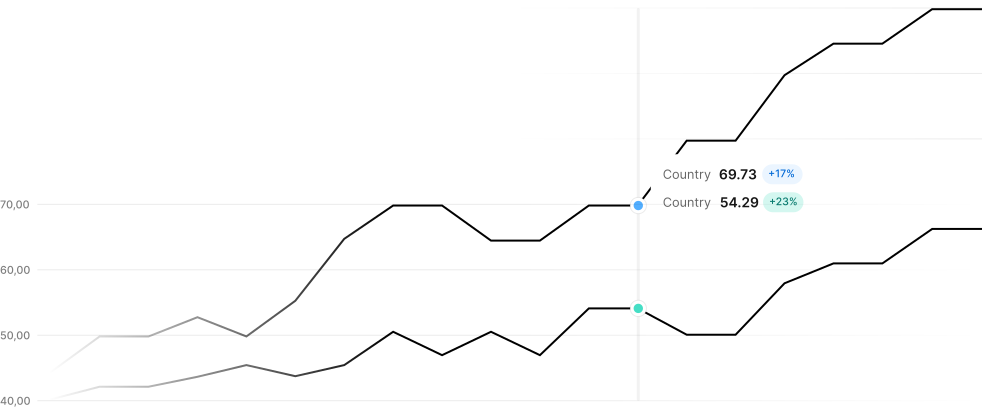
The CCPI translates a standardized set of climate metrics into a single 0-100 score per country, enabling fast comparison, peer benchmarking, and net-zero alignment monitoring across sovereigns.
BROAD COVERAGE
60+ countries. Since 2007
Comprehensive country assessments augmented by expert-based national policy scores from 450+ climate professionals worldwide.

FULL ACCESS
More than 50,000 data points
Each annual edition delivers up to 3,650 individual data points spanning all 14 indicators.
Use cases & application
From ESG scorecards to sovereign portfolio rebalancing: Whether institutions are building a fixed income strategy or responding to emerging regulatory and market requirements, the CCPI integrates into existing workflows.
ESG & 'climate alpha' analysis
CCPI data can be used to tilt sovereign exposures towards higher performing issuers in multi-asset investing based on granular country-level metrics.
See example here.
Net-zero alignment
Scores and indicators are designed to support alignment with the IIGCC Net Zero Investment Framework (NZIF).
See framework here.
Policy benchmarking & engagement
The CCPI enables the benchmarking of national climate policy ambition and implementation, facilitating structured engagement with public issuers.
See example here.
Sovereign bond performance
CCPI data has been used in academic research to examine the relationship between a country's climate transition readiness and its sovereign bond yields.
See example here.
Custom index construction
The CCPI has been used to underpin proprietary strategies, such as sovereign fixed-income indices , designed to support portfolio differentiation.
See example here.
Recognized in research and finance
The CCPI is publically referenced by leading financial institutions and cited in academic research.

"This data [CCPI] has been incorporated in the M&G Investments Sovereign Bond Framework, which is used for the sustainability analysis of government bonds and enables proprietary assessment of sovereign bonds for consideration as sustainable investments, as per the SFDR."

"For UK government bond holdings, we will use the Germanwatch Climate Change Performance Index (CCPI) scoring process (...) as a basis for monitoring and advocating for progress in line with the UK government’s net zero targets."

"Sovereign GHG emissions are covered in our net zero framework through the objective to beat the Climate Change Performance Index (CCPI) score of the ICE BofA World Sovereign Bond Index at each end of year."

Banco Bilbao Vizcaya Argentaria
Report on TCFD, 2023
"In this case [Sovereign issuers], the CCPI indicator prepared by Germanwatch has been selected: it establishes a ranking in which, according to a country’s score, a rating is assigned (very high, high, medium, low and very low) for its progress in the fight against climate change. Countries with very high and high ratings are considered to be aligned or
aligning with Net Zero."

"For sovereign bonds, we have used Germanwatch Climate Change Performance Index (CCPI) referenced by NZIF (...)"

"In the case of sovereign bonds the recommended approach is the Germanwatch Climate Change Performance Index which translates a number of metrics for each sovereign into a 0-100 score which is used to divide countries into alignment tiers which can be mapped to the NZIF alignment categories."
Frequently asked questions
Get answers to the most common questions
about the CCPI
ABOUT THE CCPI
Does the CCPI use production-based or consumption-based emissions?
How is “fair share” integrated in the CCPI?
How is climate policy performance assessed?
Are LULUCF emissions included in the GHG evaluation?
HOW IT COMPARES TO OTHERS
How is the CCPI different from other data providers?
Do users have to perform their own analysis or indicator selection?
How long has the CCPI been in use and how reliable is it?
What makes the CCPI methodology more robust than others?
Let's explore together
We have helped asset managers, insurers, and banks translate CCPI data into actionable strategies: from index construction to regulatory reporting. Every implementation started with a conversation.

© 2025 RCLM GmbH. All rights reverved.